Aluminium-Titanium Alloy Powder vs Pure Aluminium Powder: How to Choose in 2026
Your last batch of sparking stars burned dull. Your aluminium melt came out with coarse columnar grains again. Or the organoaluminum reaction just won’t hit the titanium level you need.
If any of that sounds familiar, you’re probably staring at two supplier catalogues — one for pure aluminium powder, one for aluminium-titanium (Al-Ti) alloy powder — wondering whether the Ti addition is worth the extra cost.
It is, but only for some jobs. Here’s how to tell which one you actually need.
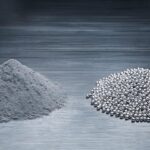
They look the same. They aren’t.
Both powders are grey, both are air-atomized, both ship as Class 4.3 dangerous goods. Open the bag and you’d struggle to tell them apart. The difference is chemistry.
Pure aluminium powder is at least 99% aluminium — just the metal, milled or atomized to your particle size. It’s a commodity reagent.
Al-Ti alloy powder is aluminium with a measured amount of titanium locked into the matrix — usually 5% (AlTi5) or 10% (AlTi10). That titanium is the whole point. It raises combustion temperature, acts as a grain-nucleating agent in molten aluminium, and supplies the Ti your chemistry needs without you having to weigh out separate powders.
Our grade is made to Q/YHS008-2022, which covers particle size, active aluminium, titanium content, and the impurity ceiling (Fe, Cu, Si, moisture). Specs are on the aluminium-titanium alloy powder page.
The four places where the choice actually matters
Pyrotechnics and fireworks
This is where Al-Ti earns its keep fastest.
Titanium burns hotter than aluminium. Add it to a sparking composition and you get a brighter, whiter, more energetic flame — the kind of effect that sells premium fireworks. Pure aluminium powder gives you the standard silver flash, but it won’t produce the high-temperature titanium spark.
If your formulation calls for “brilliant” or “high-temperature” sparking, you want Al-Ti. If you’re making a standard silver star or flash powder, pure aluminium does the job for less money.
Organoaluminum and polysilicon chemistry
Here the question is simpler: does your reaction need titanium?
In organoaluminum synthesis — aluminium alkyls for Ziegler-Natta catalysis, for instance — and in polysilicon production, the process consumes both aluminium and titanium in a fixed ratio. Feeding them as a pre-alloyed powder means faster, more uniform dissolution than dropping in a solid master alloy ingot and waiting for it to melt. Pure aluminium powder can’t supply the Ti, so it’s not an option here.
Aluminium casting grain refinement
Titanium in the melt forms TiAl₃ particles. These act as seeds — heterogeneous nucleation sites that turn coarse columnar grains into a fine equiaxed structure. The mechanism is the peritectic reaction: liquid aluminium plus TiAl₃ forms new α-aluminium grains.
A note on what we’re not selling. The high-volume foundry standard is AlTi5B1 ingot or waffle — the boron forms TiB₂, an even more potent nucleant. Jinhui’s product is the binary Al-Ti powder. It dissolves in minutes rather than the 10–15 minutes an ingot takes, which matters when you’re doing small heats, powder-metallurgy additions, or you just need refinement now. For a continuous casthouse running 50 tonnes an hour, go with AlTi5B1. For anything where speed and dispersion count, the powder wins.
Everything else: AAC, pigments, refractory, welding
Use pure aluminium powder. Full stop.
Autoclaved aerated concrete needs the gas-generating reaction of aluminium with water. Pigments need the metallic lustre of flat aluminium flakes. Refractory mixes need the thermal conductivity. Welding compounds need the exothermic heat. None of these care about titanium — it just sits there and adds cost.
For these applications, our air-atomized aluminium powder, ball-milling aluminium powder, and fine aluminium powder lines cover the full range.
Quick comparison
| Pure aluminium powder | Al-Ti alloy powder | |
|---|---|---|
| Ti content | None | 5% or 10% (AlTi5 / AlTi10) |
| Shape | Granular, spherical, or flake | Granular / spherical |
| Where it wins | AAC, pigments, refractory, welding, chemicals | Pyrotechnics, organoaluminum, polysilicon, fast grain refinement |
| Standard | GB/T 2085.1-2007 / GB/T 2085.2-2019 | Q/YHS008-2022 |
| Price floor | Set by LME aluminium (~$3/kg) | LME aluminium + titanium metal + master alloy melting |
What it costs, and why
You won’t find many public list prices for powder-form Al-Ti alloy. Most of what’s online is the master alloy ingot that gets atomized into powder. As a cost anchor, October 2026 listings show:
- AlTi5 ingot, 1 kg trial lot: about $6/kg
- AlTi5B1 bulk, 3-tonne order: $3.40–3.60/kg
- AlTi5B1, 50 kg lot: $15–40/kg
- Al-Ti-C, 500 kg lot: $10/kg
Pure atomized aluminium powder sits at $6–12/kg in small lots.
So why is Al-Ti powder more expensive? Three reasons. Titanium metal costs several times what aluminium does. Melting the two into a homogeneous master alloy takes real heat (titanium melts at 1,668 °C, aluminium at 660 °C — you’re holding the bath hot). And every batch gets tested for Ti content, active aluminium, and impurities.
For an exact number on your grade and volume, ask us for a quote. Powder prices vary more than pure aluminium because the Ti percentage and MOQ swing the number so much.
Before you send that RFQ
Save yourself a round of emails. Tell us:
- Ti content you need (5%, 10%, or something custom)
- Particle size range and D50
- Active aluminium requirement
- Impurity limits (Fe, Cu, Si, moisture)
- Standard (Q/YHS008-2022 or your own)
- Order quantity and annual volume
Send it through our contact form and an engineer gets back within a day.
FAQ
Q: Is Al-Ti alloy powder the same as Al-Ti-B grain refiner?
A: No. Al-Ti-B (like AlTi5B1) contains boron and is usually sold as ingot or waffle for high-volume foundries. Our product is binary Al-Ti powder — no boron — used where fast dissolution matters: pyrotechnics, chemical synthesis, and small-heat grain refinement.
Q: Can I just swap Al-Ti powder into my pure-aluminium process?
A: Only if your process needs titanium. In AAC, pigments, or refractory work, the Ti does nothing useful and you’re paying for nothing. In pyrotechnics or organoaluminum chemistry, you can’t get the result without it.
Q: Should I buy AlTi5 or AlTi10?
A: AlTi10 gives you twice the titanium per kilogram — hotter flames in pyrotechnics, more nucleant particles in a melt, more Ti for your reaction. It also costs more. Buy the lowest Ti content that still meets your process spec.
Q: What standard does your powder meet?
A: Q/YHS008-2022. It covers particle size distribution, active aluminium, titanium content, and impurity limits. We ship batch test reports with every order.
Q: Do you offer trial lots?
A: Yes, at a higher unit price than bulk. The per-kilogram number drops sharply once you’re buying by the tonne.
Order the aluminium powder grade you need
- aluminium-titanium alloy powder — composition and applications for the alloy route
- air-atomized aluminium powder product range — the pure aluminium grades for comparison
Request a quotation — send the grade, the quantity and the application, and we reply with technical data and pricing.
 Previous Post
 Next Post