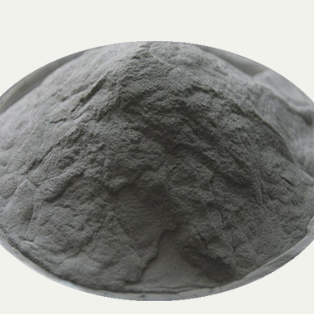
Aluminium-Titanium Alloy Powder
Q/YHS008-2022JinHui Powder manufactures aluminium-titanium alloy powder to Q/YHS008-2022 in our own plant in Inner Mongolia, China, and exports it to polysilicon and chemical producers in Europe and Asia. The titanium content is held between 0.18% and 0.30% depending on grade, active aluminium is 98% or higher, and the powder is milled and sieved into two standard cuts, FLT1 and FLT2, with the particle size and the Al/Ti ratio adjustable to the customer’s charge calculation.
What the product really sells is homogeneity: every particle carries the same aluminium-to-titanium ratio, so the analysis you run on a 100 g sample applies to the whole tonne. Each batch is composition-tested before it leaves the plant and ships with a certificate of analysis, a retained sample and full export documentation.
What an Aluminium-Titanium Alloy Powder Is
This is a master alloy in powder form, not a blend. Titanium is melted into the aluminium, so the two metals are already combined inside every particle that leaves the mill. The grade is then defined by two numbers: how much titanium the alloy carries, and how the particles are sized.
The distinction matters as soon as the powder reaches a silo. A physical blend of aluminium powder and titanium powder separates: the two have different bulk densities and different flow behaviour, so the fines drift to one side of the hopper and the ratio you charged is not the ratio that reaches the reactor. A pre-alloyed particle cannot separate from itself. That is why plants that need a known Al/Ti ratio at the reaction point buy the alloy rather than blending on site — and why our certificate reports titanium for the batch, not for a grab sample taken from the top of the bag.
Three properties are specified on top of chemistry: particle size distribution, active aluminium content and moisture. All three are printed in the table below. Titanium content is the one number that is agreed at order, because 0.18% and 0.30% are different products for the buyer even though they look identical in a bag.
How the Ratio Is Held
The ratio is fixed before the powder exists. Alloy is melted and solidified as a homogeneous ingot, and the titanium content is verified on that melt; only then is the material milled. Milling cannot un-mix an alloy, so a drift in titanium can only come from a wrong charge at the furnace, and that is caught at the ingot stage rather than at the bagging line.
Particle size is the second control and it is purely mechanical: the milled powder is sieved, and the fraction retained on each screen becomes a cut. FLT1 and FLT2 differ in how much material is allowed above 180 and 150 microns and in how much passes 45 microns — which is why they behave differently in a feeder even when the chemistry is the same.
The specification is written to our enterprise standard Q/YHS008-2022 rather than to a general aluminium powder standard. The reason is the titanium window: a general standard has no place to put a 0.18–0.30% alloying range, so the limits for titanium, and the sampling scheme used to prove them, had to be written specifically for this product. If your process was qualified against a different document, send us the limits and we will quote against yours.
Specification Table
Note: We can produce according to the customer’s requirements.
| Type | Size | Chemical Composition / % | ||||||
|---|---|---|---|---|---|---|---|---|
| Size (μm) | Percent (%) | Active Aluminium ≥ | Ti (%) | Impurity ≤ | ||||
| Fe | Cu | H₂O | Si | |||||
| FLT1 | +180 | ≤0.5 | 98 | 0.18–0.25 | 0.2 | 0.02 | 0.1 | 0.2 |
| +90 | ≤20 | |||||||
| -45 | 50–60 | |||||||
| FLT2 | +150 | ≤10 | 98 | 0.25–0.30 | 0.2 | 0.02 | 0.1 | 0.2 |
| -45 | ≥60 | |||||||
FLT1 or FLT2: Choosing a Cut
Both grades carry the same active aluminium and the same impurity limits; they differ in titanium content and in particle size. The full limits are in the specification sheet above — this table is the selection view of it.
| Grade | Oversize | Fines | Titanium | Active Al ≥ | Typical fit |
|---|---|---|---|---|---|
| FLT1 | +180 μm, 0.5% max | −45 μm, 50–60% | 0.18–0.25% | 98% | Finer, tighter cut with the lower titanium band: used where the charge is calculated on a leaner alloy and the dissolution rate has to be repeatable |
| FLT2 | +150 μm, 10% max | −45 μm, 60% min | 0.25–0.30% | 98% | Wider top cut and the richer titanium band: more titanium per tonne of powder, so less material is charged for the same titanium addition |
Read the two columns together before choosing. A coarser top cut feeds and meters more predictably and generates less dust; a higher fines fraction dissolves or reacts faster but bridges in hoppers. If your reactor was qualified on one grade, changing to the other is a process change, not a purchasing decision — trial it.
Impurities and Moisture
In this grade the impurity limits do the same job that the titanium window does: they define what is allowed to enter the customer’s process alongside the metal they actually want.
- Iron, 0.2% max. Iron is the first element most buyers screen for, because it does not alloy usefully into the reaction and it is the easiest contaminant to pick up from milling media and from handling equipment.
- Copper, 0.02% max. Held an order of magnitude tighter than iron. Copper is the classic poison in catalytic service, and at 0.02% the specification is effectively saying "no brass or bronze contamination anywhere in the line".
- Silicon, 0.2% max. Comes from refractory and from the raw metal; in a polysilicon plant it is watched because it sits in the same analytical channel as the product.
- Moisture, 0.1% max. Aluminium reacts with water to release hydrogen, so moisture is both a quality number and a safety number. It is also the property most likely to drift in storage, which is why bags are sealed and the store has to stay dry.
Active aluminium is specified at 98% minimum: the remainder is surface oxide and the alloying titanium, not metallic aluminium available to the reaction. The specification sheet lists the same limits for both grades, so switching from FLT1 to FLT2 does not change what you have to screen for — only the titanium band and the size distribution move.
Where It Is Used
Polysilicon production
Polysilicon plants buy this powder as a metered metal source, and they specify it from the reactor side rather than from a public standard: the titanium content sets the charge calculation and the size distribution sets how the powder behaves in the dosing system. Because the requirement is plant-specific, the practical question is not "which grade is best" but "which grade did your process get qualified on". We quote against the customer’s own limits when they have them, and against Q/YHS008-2022 when they do not.
Triethylaluminium (TEA) and organoaluminium production
TEA producers take aluminium as the feedstock metal, and the titanium carried by the alloy is part of what the charge calculation is built on. Two things matter more here than in most applications. The first is ratio consistency between lots: a plant that re-analyses every delivery is paying for our inconsistency, so the certificate has to be trustworthy enough to skip that step. The second is moisture, because the process is water-sensitive end to end and a damp bag is a hydrogen risk in the store before it is ever a quality problem.
Grain refinement and metallurgical addition
Powder is also a convenient way to put a small, accurate amount of titanium into an aluminium melt. A 0.18–0.30% titanium addition is in the range used for grain refinement, and a pre-alloyed particle dissolves faster and more evenly than a lump of master alloy dropped into the furnace, with no settling to the bottom of the launder. For foundries working from a melt rather than a reactor, the coarse cut usually feeds better; see our ball-milled aluminium powder range if the titanium is not required, and air-atomized powder where a more spherical granule suits the feeding equipment.
Quality Control and Batch Consistency
Every batch is composition-tested before release, and the sampling is done on the blended lot rather than on the first bag off the line:
- Titanium content by wet analysis or optical emission spectrometry, reported as the batch value
- Active aluminium by gas evolution; Fe, Cu, Si by optical emission spectrometry
- Moisture by loss on drying, and particle size by sieve analysis against the FLT1 / FLT2 cuts
- Retained sample from each batch, kept so that a question six months later can be answered with the actual powder rather than a memory
The certificate of analysis is issued against the limits you agreed at order. Third-party inspection by SGS, BV or Intertek can be arranged, and company-level REACH SVHC and RoHS documentation is available for review before you commit to a trial order.
Packing, HS Code and Transport
The export HS code follows the particle structure, not the product name: 7603.20 for aluminium powder of non-lamellar structure, 7603.10 for flake or lamellar powder. We state the code on the commercial invoice and confirm it with you before booking, because an alloy powder declared under the wrong structure code is one of the more common reasons a container is held at destination.
Aluminium powder is a dangerous good. Uncoated powder ships as UN 1396, Class 4.3 — a substance which, in contact with water, emits flammable gases — and coated powder as UN 1309, Class 4.1. The MSDS states which entry applies to the grade you order, and every shipment carries the MSDS, dangerous goods declaration, certificate of analysis, packing list and commercial invoice.
Standard packing is a 50 kg bag; 25 kg bags, 1,000 kg jumbo bags and steel drums are available for export, palletised and shrink-wrapped for container loading. Store dry and ventilated, keep acids, alkalis and oxidisers out of the same area, and never apply water, foam or CO2 to burning aluminium powder — use dry sand or a Class D extinguisher.
Frequently Asked Questions
It complies with Q/YHS008-2022, designed for polysilicon and triethylaluminium production.
Yes. Composition ratios and particle size are fully customizable according to your process requirements.
Send your target composition and quantity through the inquiry form; our sales team replies within 24 hours.
Yes. JinHui Powder is a China-based manufacturer producing aluminium-titanium alloy powder in-house and exporting to more than 50 countries.
Sample orders are welcome for testing; bulk orders typically start from 1 ton.
FLT1 carries 0.18–0.25% titanium and FLT2 carries 0.25–0.30%; active aluminium is 98% minimum in both. A titanium content outside those bands can be produced to order, but it is agreed in writing at the order stage, because it changes the charge calculation on your side. Send the figure your process was qualified on and we will quote against it.
A physical blend separates in the silo: the two powders have different bulk densities and flow behaviour, so the ratio that reaches the reactor is not the ratio that was charged. In a pre-alloyed particle the titanium is already inside every grain, so a sample from the top of the bag represents the whole tonne and the certificate can be trusted without re-analysis.
A certificate of analysis reporting titanium, active aluminium, Fe, Cu, Si, moisture and sieve analysis against the FLT1 or FLT2 cut; the MSDS and dangerous goods declaration for export; and a retained sample kept from the batch. Third-party inspection by SGS, BV or Intertek can be arranged on request.
Request a Sample or a Quotation
Send us the titanium content you need, the particle size your feeder was qualified on, the application and an estimated annual volume. We will confirm FLT1, FLT2 or a cut made to your limits, quote on FOB or CIF terms, and arrange a sample for your trial. Full contact details are on the contact page.
Compare our other aluminium powder grades
- air-atomized aluminium powder — the pure aluminium range to compare against
- ball-milled aluminium powder — the flake route and its typical applications
Related reading
- Al-Ti alloy vs pure aluminium powder — when to choose alloy over pure aluminium
- 8 key industries using aluminium powder — applications that call for alloy powder
- 3,000 tpa Al-Mg alloy powder project — progress on the alloy powder line