
Air Atomized Aluminium Powder
GB/T 2085.1-2007JinHui Powder manufactures air-atomized aluminium powder in our own plant in Inner Mongolia, China, to GB/T 2085.1-2007, and exports it to more than 50 countries. Molten aluminium is broken into droplets by a high-pressure air jet and classified into 13 standard grades from FLPA80 to FLPA2500, with particle size, active aluminium content and packaging adjustable to the buyer’s process.
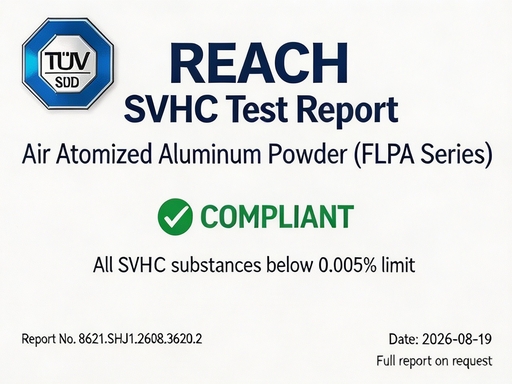
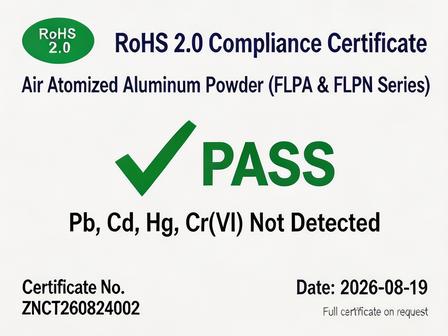
The main uses are aluminothermic reduction in ferroalloys, exothermic welding, fireworks and civil explosives, refractories, friction materials, chemical synthesis and powder metallurgy. Every batch ships with a test report covering particle size distribution, active aluminium and the Fe / Si / Cu / moisture limits printed in the specification sheet, and REACH SVHC and RoHS 2.0 test documents are available for review.
How Air Atomization Works
Air atomization is a single-step melt process. Aluminium ingot is melted in an induction furnace and superheated above its 660 °C melting point, then falls through a heated nozzle into a downward jet of compressed air. The kinetic energy of the jet tears the melt stream into droplets, which lose heat to the air and solidify within a fraction of a second while still falling through the tower. The powder is collected in a cyclone and a bag filter, then screened into the standard FLPA fractions.
Two settings decide which grade comes out: the air pressure at the nozzle, which sets how fine the droplets are, and the screen cut, which decides what is kept. Because every particle comes from the same melt, chemistry is uniform across the batch — there is no segregation of alloying elements. That is the main reason atomized powder is preferred over milled scrap in metallurgical, welding and explosive applications.
Air atomization compared with gas atomization and ball milling
Air atomization is the lowest-cost route to a clean, chemically uniform aluminium powder. Inert-gas atomization with nitrogen or argon gives rounder particles and a thinner oxide skin, which is what laser powder bed fusion needs. Air-atomized particles are more angular and carry slightly more surface oxide — an advantage in aluminothermic and exothermic reactions, where the irregular surface wets and reacts faster. Ball milling is a different product: it flattens particles into flakes for pigments, pastes and aerated concrete, and cannot match atomized powder on flow or bulk density. If you are buying ball-milled aluminium powder for a metallurgical or welding job, atomized is usually the cheaper route per unit of active metal.
Particle Size, Shape and What They Change
Air-atomized particles are irregular to semi-spherical granules, not flakes. Three properties move together as the grade gets finer:
- Surface area rises. A kilogram of FLPA80 exposes far more surface than a kilogram of FLPA2500, so it reacts faster. That is why fine grades dominate fireworks, explosives and chemical use, while coarse grades go to metallurgy.
- Flowability falls. Coarse fractions pour and meter well. Fine fractions bridge in hoppers and normally need vibration, a screw feeder or pneumatic conveying.
- Dust hazard rises. Finer fractions form explosive dust clouds more easily, so earthing, extraction and ignition control become mandatory in the handling area.
The specification sheet below gives the sieve cut for each grade. If your process is specified by a laser-diffraction D50 rather than a sieve fraction, send us the target curve — the screening window can be adjusted, and the FLPA particle size guide explains how sieve cuts and laser results map onto each other.
Specification Table
Note: We can produce according to the customer’s requirements. “—” means the item is not specified in the specification sheet.
| Type | Particle size distribution | Bulk Density (g/cm³) | Al (%) | Active Al (%) | Impurities ≤ | Applicable Industry | ||||
|---|---|---|---|---|---|---|---|---|---|---|
| Size (μm) | Percent (%) | Fe | Si | Cu | H₂O | |||||
| FLPA2500 | ≥2500 / <200 | 0.3 15 | — | 98 | — | 0.5 | 0.5 | 0.1 | 0.2 | Metallurgy and ferroalloy |
| FLPA1000 | ≥1000 / <200 | 0.3 15 | — | 98 | — | 0.5 | 0.5 | 0.1 | 0.2 | Metallurgy and ferroalloy |
| FLPA630 | ≥630 / ≥450 / <250 | 0.3 12 20 | 0.96 | — | 97 | 0.5 | 0.5 | 0.1 | 0.2 | Fireworks and explosives |
| FLPA500 | ≥500 | 0.3 | — | 98 | — | 0.5 | 0.5 | 0.1 | 0.2 | Metallurgy industry |
| FLPA450 | ≥450 / ≥250 / <140 | 0.3 10 20 | 0.96 | — | 97 | 0.5 | 0.5 | 0.1 | 0.2 | Fireworks and explosives |
| FLPA280 | ≥280 / <180 | 10 40 | 0.96 | — | 95 | 0.5 | 0.5 | 0.1 | 0.1 | Fireworks and welding |
| FLPA250 | ≥250 / ≥160 / <100 | 0.3 10 30 | 0.96 | — | 96 | 0.5 | 0.5 | 0.1 | 0.2 | Fireworks and explosives |
| FLPA180 | ≥180 / <140 | 10 45 | 0.96 | — | 95 | 0.5 | 0.5 | 0.1 | 0.1 | Fireworks, friction materials and welding |
| FLPA160A | ≥160 | 0.3 | — | 98 | — | 0.5 | 0.5 | 0.1 | 0.2 | Metallurgy and chemical |
| FLPA160B | ≥160 / <125 | 10 50 | 0.96 | — | 95 | 0.5 | 0.5 | 0.1 | 0.1 | Fireworks and chemical |
| FLPA140 | ≥140 ≥100 | 0.3 15 | 0.97 | — | 96 | 0.5 | 0.5 | 0.1 | 0.2 | Explosives and welding |
| FLPA125 | ≥125 | 5 | — | 98 | — | 0.5 | 0.5 | 0.1 | 0.2 | Chemical and refractory material |
| FLPA80 | ≥80 | 5 | — | 98 | — | 0.5 | 0.5 | 0.1 | 0.2 | Refractory material |
Packaging, Transportation and Storage
Packed in plastic bag of 50kgs each (can be customized according to customer’s requirements). Store in a well-ventilated and dry place. Do not throw or collide the packages during unloading and transportation.
Which FLPA Grade Fits Which Application
This table condenses the specification sheet into a selection aid. It covers the 13 standard grades; anything between them can be produced to order.
| Grade | Sieve size (μm) | Industry (per spec sheet) | What it is chosen for |
|---|---|---|---|
| FLPA2500 / FLPA1000 | ≤2500 / ≤1000, with ≤15% below 200 | Metallurgy and ferroalloy | Aluminothermic reduction and deoxidation: a coarse particle dissolves into the melt instead of burning at the surface |
| FLPA630 / 500 / 450 | ≤630 / ≤500 / ≤450 | Fireworks, explosives, metallurgy | Mid fractions that hold a controlled burn rate in pressed and cast compositions |
| FLPA280 / FLPA250 | ≤280 / ≤250 | Fireworks, welding | General exothermic grades; also used in welding electrode coatings |
| FLPA180 / FLPA160B | ≤180 / ≤160 | Fireworks, friction materials, welding | Finer fraction for a faster reaction, and for brake-pad friction modifiers |
| FLPA160A | ≤160 | Metallurgy and chemical | Single-cut grade with the highest active aluminium (97%) in the fine range |
| FLPA140 / FLPA125 | ≤140 / ≤125 | Explosives, welding, chemical, refractory | Fine fractions for slurry explosives and for refractory bonding |
| FLPA80 | ≤80 | Refractory material | Finest standard grade; antioxidant in carbon-bonded refractories |
Applications by Industry
Aluminothermic reduction in ferroalloys and steel
Aluminium powder is the reductant in aluminothermic production of low-carbon ferro-titanium, ferro-vanadium, ferro-molybdenum and ferro-chromium, and a deoxidiser in steel and foundry melts. Grades FLPA500 to FLPA2500 are standard here: the reaction has to run hot and stay controlled, and a very fine powder would oxidise at the surface before it could reduce the oxide it was added to. Particle size is matched to the furnace charge so the reaction front moves through the ladle rather than flashing at the top.
Exothermic welding and rail bonding
Thermite welding of rail, grounding and cathodic-protection connections blends aluminium powder with iron oxide. Consistency between batches matters more than in most applications: once a single-use crucible is lit, ignition behaviour and pour cannot be corrected. FLPA180 to FLPA450 are the usual fractions, and moisture is the property buyers check first — damp powder gives a sputtering, incomplete weld.
Fireworks, pyrotechnics and civil explosives
Mid and fine fractions act as fuel and as the source of the silver spark or glitter effect. FLPA140 to FLPA630 cover most compositions, with the exact cut chosen for burn time and for the mechanical strength of the pressed grain. In civil explosives the powder is a fuel component that raises the energy released by the blast, and buyers normally require a batch certificate plus a pre-shipment moisture check.
Refractories
Carbon-bonded magnesia-carbon and alumina-carbon bricks use fine aluminium powder as an antioxidant. It reacts with oxygen and carbon monoxide ahead of the graphite, which protects the carbon network and extends lining life, and the reaction products occupy more volume than the metal consumed, helping to seal porosity. FLPA80 and FLPA125 are the standard additions, mixed into the batch before pressing.
Friction materials
Brake pads, clutch facings and rail brake blocks use aluminium powder to raise thermal conductivity, stabilise the friction coefficient at high temperature and partly replace copper in copper-free formulations. FLPA180 and FLPA280 are the fractions most often specified; because the particle is metallic and abrasive at coarse sizes, the cut matters as much as the chemistry.
Chemical synthesis and powder metallurgy
Aluminium powder is a reducing agent and catalyst precursor in organic synthesis and in the production of aluminium chloride, and a raw material for aluminium oxide and aluminium nitride powders. In powder metallurgy it is blended for sintered aluminium parts and aluminium-matrix composites, where the semi-spherical atomized shape gives better green strength than flake. For sub-45 micron work, see our ultrafine aluminium powder range.
Quality Control and Test Reports
Each lot is sampled at the bagging line and tested before release: particle size distribution by sieve (by laser diffraction on request), active aluminium by gas evolution, iron, silicon and copper by optical emission spectrometry, and moisture by loss on drying. Results are recorded against the limits in the specification sheet, not against a generic catalogue figure.
- Certificate of analysis issued per batch and shipped with the order
- REACH SVHC test report from TUV SUD, and RoHS 2.0 compliance documentation
- Retained samples kept from every batch for traceability
- Third-party inspection (SGS, BV or Intertek) arranged at the buyer’s request
HS Code and Dangerous Goods Classification
Aluminium powder is a dangerous good. Uncoated powder ships as UN 1396, Class 4.3 — a substance which, in contact with water, emits flammable gases — in packing group II or III depending on the grade. Coated powder ships as UN 1309, Class 4.1. The export HS code is 7603.20 for powder of non-lamellar structure; flake or lamellar powder falls under 7603.10. The document set issued with each shipment is MSDS, dangerous goods declaration, certificate of analysis, packing list and commercial invoice.
For export, packing can be upgraded from the standard 50 kg bag: 25 kg bags, 1,000 kg jumbo bags and steel drums are available on request, and bags can be palletised and shrink-wrapped for container loading.
Never apply water, foam or CO2 to burning aluminium powder — it reacts with water to release hydrogen. Use dry sand or a Class D extinguisher, and keep the storage area free of acids, alkalis and oxidisers.
Frequently Asked Questions
It is produced in accordance with GB/T 2085.1-2007, with grades FLPA80 to FLPA2500 for metallurgy, chemical, refractory, friction material, explosive, fireworks, welding and ferroalloy applications.
Yes. We can produce according to the customer’s requirements. Contact us for details.
It is packed in plastic bags of 50 kg each, and packaging can be customized according to customer’s requirements. Store in a well-ventilated and dry place.
Yes. JinHui Powder is a China-based factory manufacturing air-atomized aluminium powder in-house and exporting to more than 50 countries.
Samples are welcome for testing; bulk orders typically start from 1 ton. Contact us for details.
Air atomization uses compressed air as the atomizing medium and is the lower-cost route; the particles are more angular and carry slightly more surface oxide. Gas atomization with nitrogen or argon gives rounder particles, lower oxygen and better flow, which is preferred for additive manufacturing. For metallurgical, welding and pyrotechnic use, air-atomized powder is normally the better value.
Yes. Uncoated aluminium powder ships as UN 1396, Class 4.3, packing group II or III; coated powder ships as UN 1309, Class 4.1. We issue the MSDS and the dangerous goods declaration with every shipment and load in ventilated containers.
Yes. Each batch is tested for particle size distribution, active aluminium, Fe, Si, Cu and moisture, and the certificate is issued against the limits in the specification sheet. Third-party inspection can be arranged on request.
Request a Sample or a Quotation
Send us the grade or target particle size, the application and an estimated monthly volume. We will confirm the closest FLPA grade, quote on FOB or CIF terms, and arrange a sample for your trial.
Compare our other aluminium powder grades
- ball-milled aluminium powder — the flake route — lower cost, different reactivity
- fine aluminium powder — the fine grade range and FLPA particle sizes
Related reading
- Atomized vs ball-milled: price comparison — where atomised powder sits on cost
- Fine vs spherical aluminium powder — the boundary between spherical and fine powder
- Aluminium powder atomization patent — our own atomisation patent