Fine vs Spherical Aluminium Powder: How to Choose the Right Grade in 2026
Buyers searching for aluminium powder quickly run into two product families that look similar on a datasheet but behave very differently in production: fine aluminium powder and spherical aluminium powder. Pick the wrong one and you usually get poor flow, inconsistent dosing, or a failed trial batch. Here are the real differences, which applications each grade serves best, and what to specify when you request a quotation.
Quick Answer: Which One Do You Need?
If your process depends on high surface area and chemical reactivity — aerated concrete, chemical reactions, solar cell pastes, pigments — you need fine aluminium powder (typically irregular or flake morphology, sub-45 µm). If your process depends on flowability, packing density and predictable melting — thermal spraying, additive manufacturing feedstock, powder metallurgy — you need spherical aluminium powder produced by atomization. When in doubt, match the powder to the process constraint, not the chemistry: both grades are the same metal.
What “Fine” and “Spherical” Actually Mean
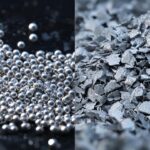
The two terms describe different properties, which is where confusion starts. “Fine” refers primarily to particle size (a fine powder can be irregular, flake or near-spherical), while “spherical” refers to particle shape. In commercial practice, however, the terms map onto two distinct production routes and two distinct product behaviours.
Fine aluminium powder
Fine aluminium powder usually means material classified to narrow, sub-sieve size cuts — common commercial grades run from D50 ≈ 5 µm up to 45 µm. Depending on the production route it may be irregular (air-atomized and classified) or flake (ball-milled). The defining characteristic is a high specific surface area, which drives reactivity: fine powders ignite more readily in AAC production, react faster in chemical synthesis, and disperse better in conductive pastes for solar cells. Our fine aluminium powder line covers classified grades for these reactive applications.
Spherical aluminium powder
Spherical aluminium powder is produced by air atomization: molten aluminium is broken into droplets by a high-velocity air stream, and surface tension pulls each droplet into a near-perfect sphere before it solidifies. The spherical shape gives the powder its signature properties — free flow, high apparent and tap density, low oxide content per unit volume, and uniform melting behaviour. These are exactly the properties demanded by thermal spray guns, powder-bed AM machines and powder metallurgy presses. See our air atomized aluminium powder specifications for typical size ranges.
How the Production Process Shapes the Powder
Three mainstream routes produce commercial aluminium powder, and each locks in a different shape-size combination:
- Air atomization → spherical or near-spherical particles, typically 15–150 µm as-atomized, classifiable into narrower cuts. Best flowability and packing density.
- Ball milling → flat flake particles (“lamellar”), measured by flake diameter and thickness rather than mesh size. Maximum surface area per gram; the standard choice for AAC, pigments and pyrotechnic applications. Our ball milled aluminium powder is produced this way.
- Classification of atomized powder → fine spherical cuts (e.g. −325 mesh) that combine small size with good flow, at a price premium over irregular fine powder.
The practical consequence: when a supplier quotes a “fine spherical” grade, you’re paying for two process steps — atomization plus precision air classification. That premium is only worth paying if your process genuinely needs both properties.
Application-by-Application Selection
Autoclaved aerated concrete (AAC)
AAC needs a controlled hydrogen evolution reaction between aluminium and the alkaline slurry. Flake or fine irregular powder with high surface area gives the classic, predictable gas-release curve. Spherical powder reacts too slowly and too late for most AAC formulations. Choose: fine / flake.
Solar cell metallization pastes
Conductive pastes need powders that disperse uniformly and sinter cleanly through the printing and firing cycle. Fine, narrowly classified spherical or near-spherical powder (typically 1–10 µm) is preferred because paste rheology depends on packing behaviour. Choose: fine spherical (classified).
Thermal spraying
Flame and arc spray guns feed powder through a hose and nozzle — irregular fine powder bridges and clogs. Free-flowing spherical powder in the 15–75 µm range is the industry default. Choose: spherical.
Additive manufacturing feedstock
Powder-bed processes require excellent spreadability: spherical shape, controlled satellites, narrow PSD (commonly 15–53 µm for LPBF). Only atomized and classified grades qualify; buyers should confirm oxygen content and flow rate (Hall flow) on the certificate of analysis. Choose: spherical, certified for AM.
Chemical synthesis and metallurgy
Reaction-driven uses (reduction, deoxidation, alloying additions) are governed by surface area. Fine irregular or flake powder delivers the fastest kinetics per dollar. Choose: fine.
Pigments, coatings and printing inks
Metallic visual effects depend on flake geometry — the “leafing” behaviour of aligned flakes creates the chrome look. This is the home territory of ball-milled flake powder. Choose: flake (ball-milled).
Fine vs Spherical: Side-by-Side Comparison
| Property | Fine Aluminium Powder | Spherical Aluminium Powder |
|---|---|---|
| Typical size | D50 5–45 µm | 15–150 µm (classified cuts available) |
| Shape | Irregular or flake | Near-perfect sphere |
| Production route | Ball milling, or atomization + classification | Air atomization |
| Flowability (Hall flow) | Poor to moderate | Excellent — free flowing |
| Apparent density | Low to moderate | High (≈1.3–1.5 g/cm³ typical) |
| Specific surface area | High → high reactivity | Low → stable, predictable melting |
| Best-fit processes | AAC, chemical synthesis, pigments, solar pastes | Thermal spray, AM feedstock, powder metallurgy |
| Relative cost (same purity) | Lower (irregular) / higher (classified spherical) | Moderate; classified fine cuts carry a premium |
Spec Checklist to Send Your Supplier
Quotation requests that include the following points get accurate prices on the first reply — and expose suppliers who cannot actually control their process:
- Particle size distribution — D10/D50/D90 by laser diffraction, not just a mesh range.
- Shape requirement — state explicitly: spherical, irregular, or flake. Ask for SEM images of the actual lot.
- Purity and oxygen content — 99.7% Al minimum for most industrial uses; AM feedstock buyers should demand O₂ on the CoA.
- Flow and density data — Hall flow rate and apparent/tap density if your process feeds or packs the powder.
- Application disclosure — tell the supplier the end process. A manufacturer that produces both fine and spherical grades can recommend honestly; a trader cannot.
- Samples before bulk — 1–5 kg trial lots against your own process test beat any datasheet.
JinHui Powder produces both air-atomized spherical grades and ball-milled fine/flake grades in-house at our Inner Mongolia plant, so we can quote both sides of this comparison without bias. Contact us with your D50 target and application for a specification-matched quotation.
FAQ
Q: Is spherical aluminium powder always more expensive than fine powder?
A: Not necessarily. Standard as-atomized spherical grades (e.g. −100 mesh) are competitively priced because atomization is a one-step, high-throughput process. Costs rise when you need narrow classification — a 15–45 µm AM cut costs noticeably more than the same chemistry at −100 mesh. Fine irregular powder is usually the cheapest option per kilogram.
Q: Can I substitute fine powder for spherical powder in thermal spraying?
A: It’s not recommended. Fine irregular powder flows poorly through feed hoses, causes pulsing at the nozzle, and produces uneven coatings with higher porosity. The spray-gun OEM’s specified size and shape range exists for this reason.
Q: What does “−325 mesh” mean in aluminium powder specifications?
A: It means the powder passes through a 325-mesh screen (nominal aperture 44 µm). It’s a legacy sieve designation — it tells you the upper size limit but nothing about the distribution below it. For critical applications, always convert to a laser-diffraction D10/D50/D90 specification.
Q: How should fine aluminium powder be stored and handled?
A: Keep it dry, sealed, and away from ignition sources. Fine powders have high surface area and form combustible dust clouds; handling areas should follow standard metal-dust safety practice (no open flames, grounded equipment, dust extraction). Your supplier should provide an SDS with the lot.
Q: Do you supply both grades with trial quantities?
A: Yes. We ship 1–5 kg samples of both our fine and spherical (air-atomized) aluminium powder grades internationally, with full CoA and PSD data, so you can validate the powder in your actual process before committing to bulk orders.
Order the aluminium powder grade you need
- fine aluminium powder product range — the fine grade range on the product page
- air-atomized aluminium powder product range — the spherical grade range for comparison
Request a quotation — send the grade, the quantity and the application, and we reply with technical data and pricing.
 Previous Post
 Next Post