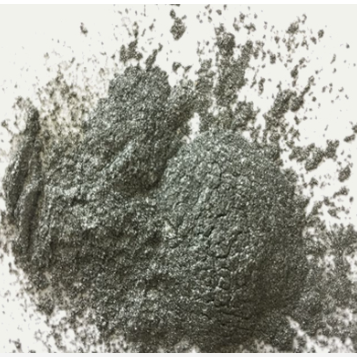
Aluminium Powder by Ball Milling
GB/T 2085.2-2019JinHui Powder manufactures ball-milled aluminium powder in our own plant in Inner Mongolia, China, to GB/T 2085.2-2019, and exports to more than 50 countries. Aluminium granules are flattened in ball mills into lamellar particles of controlled thickness, then classified and sieved into 17 standard grades from FLQ45 to FLQ1600, with particle size, bulk density and active aluminium content adjustable to the buyer’s process.
The main uses are gas generation in autoclaved aerated concrete, leafing pigments for anti-corrosion and decorative coatings, spark effects in fireworks, pesticides and chemical synthesis, civil explosives, and sintered aluminium parts. Every batch ships with a test report covering particle size, bulk density, floating rate, covering power on water and the Fe / Si / Cu / moisture limits printed in the specification sheet.
How Ball Milling Produces Aluminium Powder
Ball milling is a mechanical process, not a melting one. Aluminium granules or a coarse atomized feed are charged into a rotating cylinder partly filled with hardened steel balls. As the drum turns, the balls rise and cascade, and each impact and shear event flattens a particle instead of breaking it. A small addition of stearic acid or a similar milling aid keeps the fresh aluminium surfaces from cold-welding back together and controls how thin the flake becomes.
Three settings decide the product. Milling time sets flake thickness: a longer run gives thinner, wider flakes with a higher aspect ratio and a lower bulk density. The milling aid dose sets how much of the surface stays coated, which in turn drives the floating rate in paint systems. The screen cut decides what is packed: after milling, the powder goes through air classification and sieving, and the retained fraction on each screen becomes a grade. The 17 grades in the specification sheet below are combinations of those three settings, not different raw materials.
Ball milling is also the reason this product behaves differently from air-atomized aluminium powder. An atomized particle is a compact, roughly equiaxial granule; a milled particle is a flat platelet. Same chemistry, different geometry — and the geometry is what most applications actually buy.
What the Flake Shape Changes
A milled flake is typically twenty to a hundred times wider than it is thick. That single fact produces the three properties that buyers actually specify on:
- Bulk density falls. Loose flake stacks poorly, so apparent density runs from above 1.0 g/cm³ for the coarse sintered grades down to about 0.3 g/cm³ for the finest pigment grades. Storage and dosing equipment sized for atomized powder will hold less of it per litre, and screw feeders usually need recalibration.
- Floating rate rises. A thin, coated flake floats on water and turns over to lie flat at the surface. The specification sheet measures this as floating rate (80% minimum for the FLQ80A, FLQ56 and FLQ45 leafing grades) — the standard check that a pigment will still leaf in a solvent-borne paint.
- Covering power rises. Because the flakes overlap in parallel layers, a small mass covers a large area. The covering on water column gives that area directly: 0.9 m²/g for FLQ45 against 0.42 m²/g for FLQ80D, which is why the finest grades are chosen when metal loading has to be cut.
In a coating, the flakes align parallel to the substrate as the film dries and set up overlapping barriers. That is why the same aluminium pigment gives corrosion protection in a primer that a spherical particle of equal mass cannot match: moisture and ions have to travel a tortuous path between platelets.
Specification Table
Note: We can produce according to the customer’s requirements. “—” means the item is not specified in the specification sheet.
| Type | Particle size distribution | Bulk Density (g/cm³) | Floating Rate (%) ≥ | Covering on Water (m²/g) ≥ | Applicable Industry | Chemical Composition /% | |||||||||
|---|---|---|---|---|---|---|---|---|---|---|---|---|---|---|---|
| Size/μm ≥ | Percent ≤ | Active Al ≥ | Impurities ≤ | Al₂O₃ | |||||||||||
| Fe | Si | Cu | Mn | H₂O | Oil | Cu+Zn | |||||||||
| FLQ1600 | 1600 | 0.5 | >1.0 | — | — | Sintered aluminium powder | ≤89.9 | 0.7 | — | — | — | 0.1 | 0.3 | — | 9.0–11.0 |
| FLQ850 | 850 | 3.0 | >1.0 | — | — | Sintered aluminium powder | ≤87.8 | 0.7 | — | — | — | 0.1 | 0.4 | — | 11.0–14.0 |
| FLQ355A | 355/160 | 0.3/8 | ≥0.3 | — | — | Pesticide, chemical, explosive | 94 | 0.7 | 0.5 | — | — | 0.08 | 0.7 | 0.05 | — |
| FLQ355B | 355/160 | 5/30 | ≥0.3 | — | — | Pesticide industry | 94 | 0.7 | 0.5 | — | — | 0.08 | 0.7 | 1.0 | — |
| FLQ250 | 250/100 | 0.3/8 | ≥0.4 | — | — | Pesticide, chemical, explosive | 94 | 0.7 | 0.5 | — | — | 0.08 | 0.8 | 0.05 | — |
| FLQ224 | 224/80 | 0.3/10 | ≥0.5 | — | — | Pesticide, chemical, explosive | 92 | 0.8 | 0.7 | — | — | 0.08 | 0.9 | 0.05 | — |
| FLQ160 | 160/63 | 0.3/12 | ≥0.5 | — | — | Pesticide, chemical, explosive | 90 | 1.0 | 0.8 | — | — | 0.08 | 1.0 | 0.05 | — |
| FLQ80A | 80 | 1.0 | — | 80 | 0.6 | Corrosion-resistant paints, chemical catalyst | 82 | 0.6 | 0.6 | 0.1 | 0.01 | 0.1 | 3.55 | — | — |
| FLQ80B | 80 | 1.5 | ≤0.25 | — | — | Aerated concrete industry | 90 | — | — | — | — | — | 3.5 | — | — |
| FLQ80C | 80 | 1.0 | ≤0.22 | — | — | Fireworks industry | 80 | — | — | — | — | — | 3.5 | — | — |
| FLQ80D | 80 | 1.0 | — | — | 0.42 | Aerated concrete industry | 85 | — | — | — | — | — | 2.8 | — | — |
| FLQ80E | 80 | 1.0 | — | — | 0.6 | Aerated concrete industry | 85 | — | — | — | — | — | 2.8 | — | — |
| FLQ80F | 80 | 0.5 | — | — | 0.6 | Aerated concrete industry | 85 | — | — | — | — | — | 3.0 | — | — |
| FLQ63A | 63 | 1.0 | ≤0.25 | — | — | Aerated concrete industry | 88 | — | — | — | — | — | 3.5 | — | — |
| FLQ63B | 63 | 1.0 | ≤0.22 | — | — | Fireworks industry | 80 | — | — | — | — | — | 3.5 | — | — |
| FLQ56 | 56/45 | 0.3/0.5 | ≤0.22 | 80 | 0.7 | Corrosion-resistant paints, chemical catalyst | 82 | 0.6 | 0.6 | 0.1 | 0.01 | 0.1 | 3.55 | — | — |
| FLQ45 | 45 | 0.1 | ≤0.22 | 80 | 0.9 | Corrosion-resistant paints, chemical catalyst | 80 | 0.6 | 0.6 | 0.1 | 0.01 | 0.1 | 3.55 | — | — |
Choosing an FLQ Grade
This table condenses the specification sheet into a selection aid. Sieve sizes and industries are as printed above; anything between two grades can be produced to order.
| Grade | Sieve size (μm) | Industry (per spec sheet) | Why this cut is chosen |
|---|---|---|---|
| FLQ1600 / FLQ850 | 1600 / 850 | Sintered aluminium powder | Coarse, dense and slow to react; used where the powder has to survive handling and dissolve into a melt or a press charge |
| FLQ355A / FLQ355B | 355, fine cut at 160 | Pesticide, chemical, explosive | Wide size spread at the coarse end; the A grade carries a lower oil content, the B a higher one |
| FLQ250 / FLQ224 / FLQ160 | 250, 224, 160 | Pesticide, chemical, explosive | The working range for chemical conversion, stepping finer as the required reaction rate rises |
| FLQ80A / FLQ56 / FLQ45 | 80 / 56 / 45 | Anti-corrosion paint, chemical catalyst | Leafing pigment grades: floating rate 80% minimum and the highest covering power in the range |
| FLQ80B / FLQ80D / FLQ80E / FLQ80F | 80 | Aerated concrete | Gas-forming grades; the letters mark different bulk density and covering values for different slurry densities |
| FLQ63A | 63 | Aerated concrete | Finer gas-forming cut for thin-wall or high-strength AAC recipes |
| FLQ80C / FLQ63B | 80 / 63 | Fireworks | Spark and glitter effect; the cut sets burn time and the size of the light burst |
Applications by Industry
Autoclaved aerated concrete (AAC)
In AAC the powder is the gas-forming agent. Mixed into a cement-lime-sand slurry it reacts with the alkali to release hydrogen, and the bubbles that form become the closed porosity that gives the block its low density and its thermal insulation. What the block plant needs is a reproducible gas evolution curve: too fast and the cake collapses before it sets, too slow and the expansion is incomplete. FLQ80B, FLQ80D, FLQ80E, FLQ80F and FLQ63A cover the common recipes, and the choice is normally made against slurry density and target dry density rather than against price per tonne.
Anti-corrosion and decorative coatings
FLQ45, FLQ56 and FLQ80A are leafing pigments for solvent-borne primers, heat-resistant aluminium paints and decorative finishes. In the can the flakes stay suspended; in the film they float to the surface and overlap, so a thin coat still gives full metallic opacity and a continuous barrier against water and chloride. Buyers usually specify on three numbers together — floating rate, covering on water and moisture — because a pigment that leaves the film porous fails in service even when its chemistry is on specification.
Fireworks and pyrotechnics
Milled flake is the source of the silver spark in fountains, strobes and glitter compositions. The flat geometry burns differently from a granule: the flake ignites across its face, which produces the bright, crackling effect and the longer visible trail. FLQ80C and FLQ63B are the usual cuts, and the packed density of the composition is matched to the flake bulk density so that the grain presses to a consistent strength.
Pesticides and chemical synthesis
The pesticide, chemical and explosive grades (FLQ355A/B, FLQ250, FLQ224, FLQ160) are consumed as a raw material rather than as a pigment, so the priorities shift to chemistry and reactivity: active aluminium high, iron and copper low, moisture controlled, and a size spread that dissolves or reacts at a predictable rate. Because these are conversion processes rather than formulations, buyers tend to lock a grade and audit that it does not drift between lots.
Civil explosives
Aluminium powder raises the energy released by an explosive composition and lengthens the pressure pulse. Coarse and mid cuts are used so the reaction is not instantaneous, and moisture is the first property checked on arrival — damp powder not only underperforms, it can react with water to release hydrogen in the magazine.
Sintered aluminium and metallurgical use
FLQ1600 and FLQ850 are the coarse, high-bulk-density grades for sintering blends, deoxidisers and aluminothermic charges, where a dense particle mixes and feeds better than a fine flake. For sub-45 micron work the requirement usually moves to a finer, more spherical product — see our ultrafine aluminium powder range, which is classified by laser D50 rather than by sieve cut.
Quality Control and Test Reports
Each lot is sampled at the bagging line and released against the limits printed in the specification sheet, not against a catalogue average:
- Particle size by sieve analysis, with laser diffraction on request for the fine cuts
- Bulk density and, for pigment grades, floating rate and covering on water
- Active aluminium by gas evolution, and Fe, Si, Cu, Mn by optical emission spectrometry
- Moisture and oil by loss on drying and extraction
- Retained samples from every batch, kept for traceability and for settling a claim without argument
The certificate of analysis ships with the order. Third-party inspection by SGS, BV or Intertek can be arranged at the buyer’s request, and REACH SVHC and RoHS documentation is available for review before you place an order.
Packing, HS Code and Transport
Ball-milled powder is a lamellar product, so the export HS code is 7603.10 — powder of lamellar structure. Non-lamellar, atomized powder falls under 7603.20, and a declaration that mixes the two codes is one of the most common reasons a shipment is held at destination.
Classification depends on the coating. Powder carrying a milling aid normally ships as UN 1309, Class 4.1 (flammable solid); uncoated powder ships as UN 1396, Class 4.3 (substance which, in contact with water, emits flammable gases), packing group II or III. The MSDS states which entry applies to the grade you order, and the dangerous goods declaration, certificate of analysis, packing list and commercial invoice are issued with every shipment.
Standard packing is a 50 kg bag. For export it can be upgraded to 25 kg bags, 1,000 kg jumbo bags or steel drums, palletised and shrink-wrapped for container loading. Never apply water, foam or CO2 to burning aluminium powder — it reacts with water to release hydrogen. Use dry sand or a Class D extinguisher, keep the store dry and ventilated, and keep acids, alkalis and oxidisers out of the same area.
Frequently Asked Questions
It is produced in accordance with GB/T 2085.2-2019, covering grades from FLQ45 to FLQ1600 for sintered aluminium products, pesticides, chemicals, explosives, aerated concrete, fireworks and anti-corrosion coating applications.
Yes. We can produce according to the customer’s requirements. Contact us for details.
Please visit our contact page at https://www.nmgjinhui.cn/contact-us/ and tell us your target specification; our team will reply with grades, specifications and a quotation.
Yes. JinHui Powder is a factory-based manufacturer in China, producing ball-milled aluminium powder in-house and exporting to more than 50 countries.
Sample orders are welcome for testing; bulk orders typically start from 1 ton. Contact us for a tailored quotation.
Ball milling flattens the particle into a thin flake, which gives a low bulk density, a high floating rate and a high covering power; it is the right choice for pigments, aerated concrete and pyrotechnic effects. Air atomization produces a compact, roughly spherical granule with better flow and a higher bulk density, which suits metallurgy, welding and explosive compositions. The chemistry can be identical; the geometry is the difference.
FLQ80B, FLQ80D, FLQ80E, FLQ80F and FLQ63A are the gas-forming grades used in aerated concrete. The right one depends on your slurry density, target dry density and casting temperature, because those set the gas evolution curve. Send us your recipe and we will recommend a grade and a trial quantity.
Yes. Coated powder carrying a milling aid normally ships as UN 1309, Class 4.1; uncoated powder ships as UN 1396, Class 4.3, packing group II or III. The export HS code for lamellar aluminium powder is 7603.10. The MSDS and the dangerous goods declaration are issued with every shipment.
Request a Sample or a Quotation
Send us the FLQ grade or the application, the target particle size and an estimated monthly volume. We will confirm the closest grade, quote on FOB or CIF terms, and arrange a sample for your trial. Full contact details are on the contact page.
Compare our other aluminium powder grades
- air-atomized aluminium powder — the spherical alternative — compare shape, density and cost
- aluminium-titanium alloy powder — the alloy route when you need more than pure aluminium
Related reading
- Atomized vs ball-milled: price comparison — the cost difference between ball milling and atomisation
- Aluminium powder for AAC — typical use of flake ball-milled powder in building materials
- Huolinguole aluminium processing cluster — local cluster and raw-material advantages